All you need to know about locks and picking them

Latest

Defeating the DOM IX

Last week I was forced to drill a Dom lock on a real lockout. I always feel bad when doing so ,even when sometimes it’s the only option (like glued locks etc.)

I’ve already covered the Dom locks in my blog and they are very hard to pick but possible. The trouble is on a real door when you lose the comfort of your vice and most of the time there’s a lock protector which makes it harder to tension.

I spent a few good hours on finding a better solution to this lock and found out that the  foil is the best way.  However there might be some problems when using this method.


I have five different  locks and three of them pick very easy,  one lock will pick but it will be impossible to remove the key after, I suspect the higher cuts( pin number 5) is going far too deep in the foil key , and the last lock will not pick and when I’ve looked more into the lock I’ve discovered that where it should have been pin number one it went all the way to the last pin for some reason. Also with this lock it is better to use pliers as bigger forced is needed.


To overcome those problems I’ve cut a substantial amount of the key  and since there isn’t a complex warding the key is working much better now  and will go on very smoothly.


Here is a video on how it’s done.


Also  here’s a quick look on my new lock  training borad I’ve made this week.


Protected: Electric Dimple Bump Gun

This content is password-protected. To view it, please enter the password below.

Tips on using the Lishi 2 in 1 Picks

Hello all,


Not much time in my hands lately but I was asked by a few friends to share some tips on picking and decoding the HU 101 Ford lock. This lock is harder to pick since it has 10 wafers and 5 different heights and would easily go in a false setting.

However ,I found that there is a way to pick them faster and it is working for me.

Here is a video on the Ford lock


I was also very impressed with the NE72 (Peugeot/Renault)pick and made a short video


A word of a warning if I may , apparently there are fake Lishi picks in the available in the market now and I had a play with one on a Merc HU64, the fake pick did open the lock but is giving the wrong code since the needle is a bit off-balanced and shorter.


Till next time,


Raf

Dom Diamant (Diamond) – The Rolls Royce of Locks?

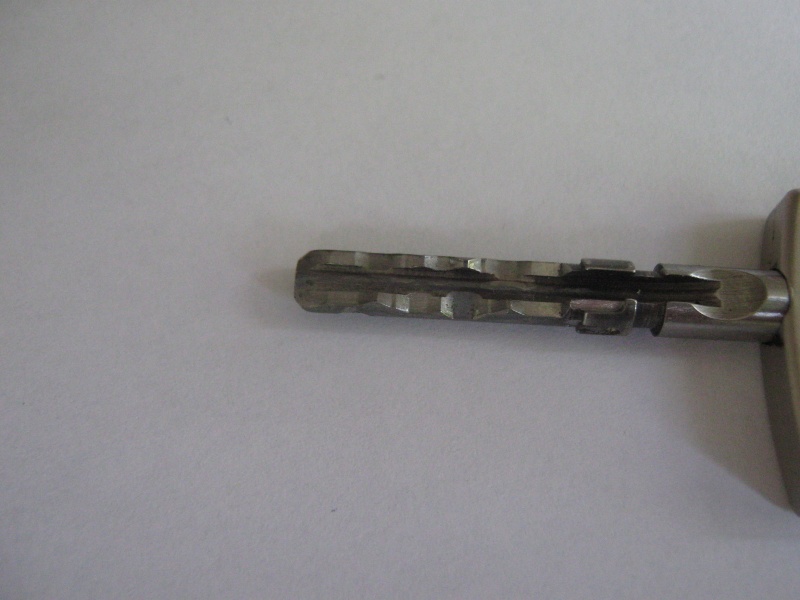
Here is a quick look of what must be one of the best engineered locks I’ve ever seen – the German Dom Diamant ( Diamond).

This lock was kindly given to me by Inalock from the DBC forum and was delivered by the almighty Mikey from Manchester.

First of  all this lock has a very unique key ,which  I can’t think of any way you can copy it without the real cutting machine.


The lock contains 10 discs that operates 3 (!) side bars

In the lock that I got one side bar was missing so I had to make a new one.

The side bars are in every 90 degrees of the core but one side is not a side bar but it has a spring attachment to it that prevents the discs from fully turning.


Inside the core you would find the discs with some very interesting spacers that look like four O rings which basically means that when you move one of the discs , the one next to it will move as well.

 This is the side bar  with the key in.

 The discs have false notches in them and they look like the letter B but some are in reverse.

Another unique thing that I learned from this lock is that discs do move  when the key is inserted/extracted  and unlike the Abloy they are not turned into a certain place which moves the bolt. In here the key immediately opens the lock

I’m still studying this locks but it is a very unique lock and very  very well made.

Protected: Overlifting Safe locks

This content is password-protected. To view it, please enter the password below.

ELF Convention 2011

I was too busy to write  lately and not because I am out of locks or ideas ,it’s just that Israel just held the ELF (European locksmith association) in Tel Aviv  and a 5 mints walk from my house .

 In the convention I was presenting the Lishi 2 in 1  and the VAG & BMW  decoders which are made in here. I was very busy in the show which is a good sigh and does make me proud to be able to help other locksmiths and meeting some was a real pleasure.

I was also very lucky to host a real NDE specialist from England ,some of you may know him from the forums as E3locks.

E3 is a true gentleman and a real lock  lover and we spent a real great 5 days of picking and drinking beers.

The other guy that worths mention is Steve Gallagher which gave a once in a life time car opening course . There is not enough words to describe how professional and knowledgable this  guy is  with cars and we also had him over my flat for a few drinks and dinner , Steve had some very funny stories to tell as well.

The are still many stories  but I’m still very  short of time but my next post is about overlifting and defeating a double sides safe keys! so  watch out for this space.

Here are 2 video E3 took of the convention ,the first one is me explaining Steve how the Lishi decoder works ,the other video is on a real car that was hired for the show.

THANK YOU E3 FOR A GREAT TIME!

Using Depth & Space Keys -Part One


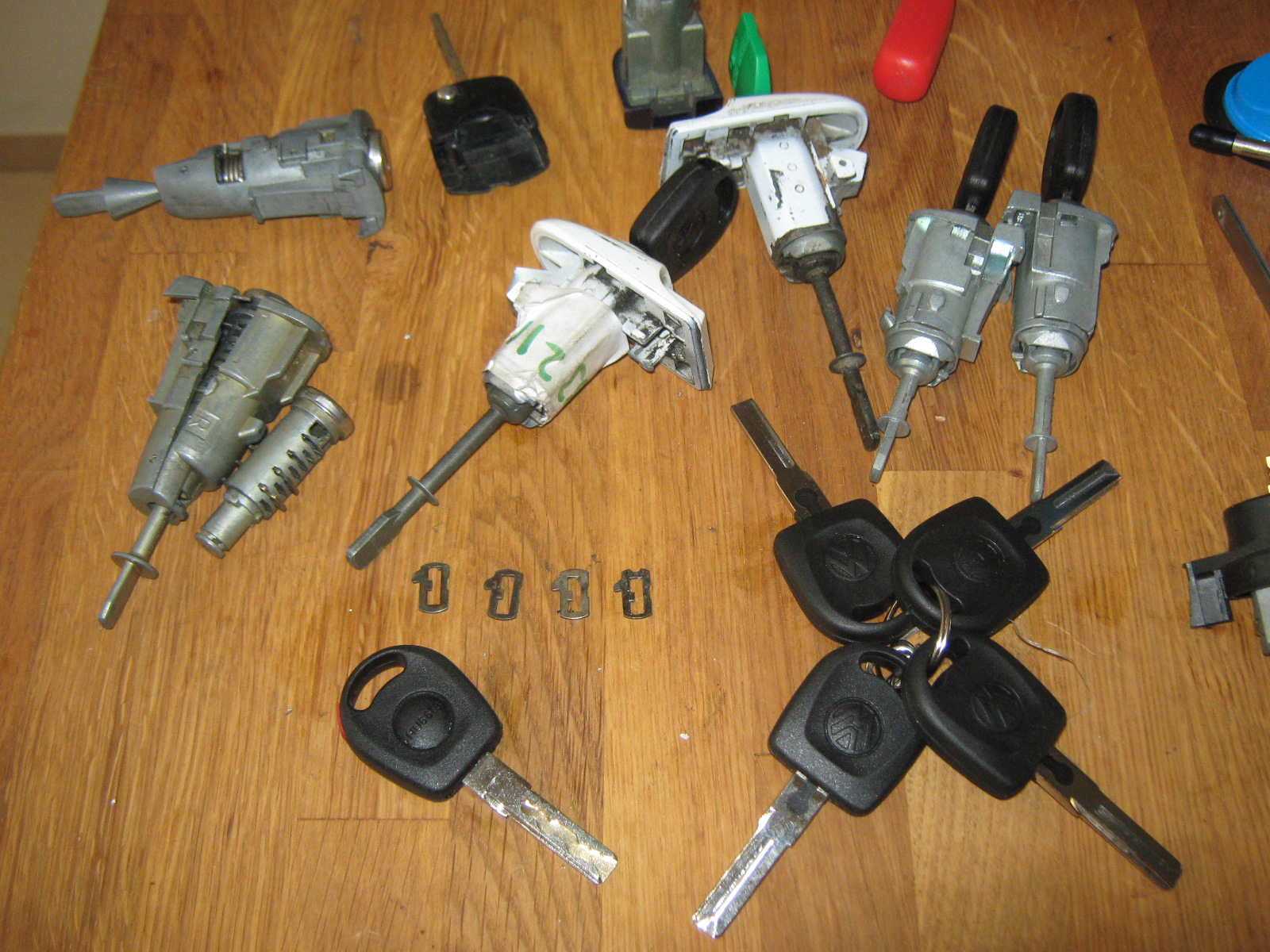
Here is a quick look on how to use depth and space keys in order to make  keys, I will demonstrate them on VAG keys because they don’t have codes on them and usually they are not that difficult to decode.

VAG group locks has 8 wafers with 4 different heights that are 1 2 3 4 , those keys are used on VW Skoda Audi Seat & Porsche

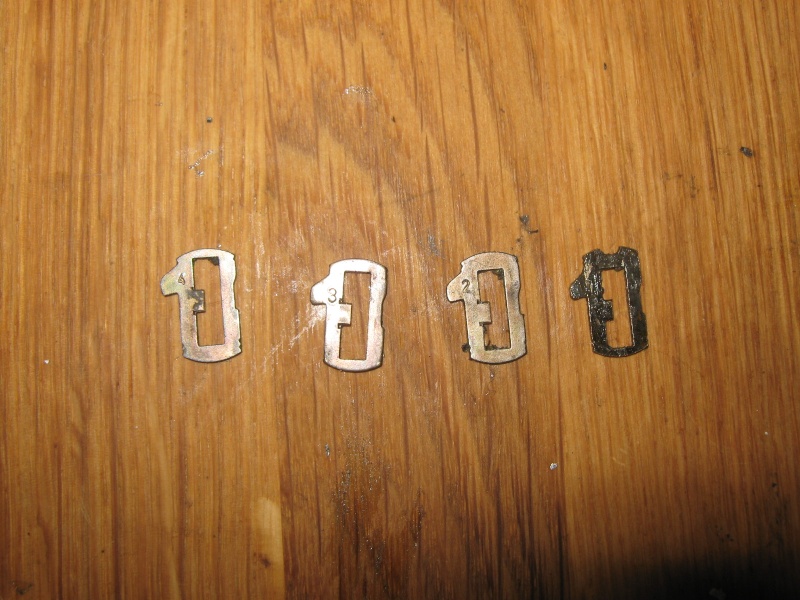
The number 1 wafer  (first to the right) is from a newer lock that has traps inside,when using the VW decoder it will not reveal the true code of that wafer and a software is needed to find it out. Lishi  2 in 1 pick has  no problem with this lock.

First thing to know and remember is that there is never a jump from wafer 4 to wafer 1 so wafer 4 can only be followed by 2 or 3 and it’s the same for wafer number 1.  The lock will never work properly with this combination.

The D &S keys are 4 keys that are cut to each position and they are double-sided. 

This is key No. 1 with four wafers on it ,only the first wafer is at the sheer line.

And this is key No.4

The VAG locks spacing is one up one down and usually found in cars from 1998 to 2002,the other models are two up two down

This is the old type lock

So for a locksmith that has a  cut to code machines,  making those keys shouldn’t be a problem and even if one or two of the codes are not certain ,you can always cut them deeper, but if you don’t have those machines you would have to use those S&D keys on a  dimple laser cutting machine.

So there are two main options ,one is dismantle the lock and the other is to decode it. (see my other sections on how they are decoded ).

If the lock is in your hand ,on the older types of locks you would get numbers on each wafer that will tell you what they are, if not you insert the S&D keys  to determine the code.

 Here is key No.1 inside the locks and it reveals that wafer No.1 is not in the lock. If you look closely you can see how the tolerance is not so good with wafers No.1 &2 ,even though the wafer is not correct it is still in the sheer line.

Key No. 2

Here is the third key

So basically now the fourth key is not needed as No.4 is all that left

So now that the code is known we can cut this key on the cutting machine ,another good use of the S&D keys is to copy keys to code.

This is a key that we need to know its code

The is key No. 1 and it reveals the positions No. 3 4 5 are number 1 wafers

The second key reveals that positions 1 &2 are wafers number 2

And the third key tells us the positions number 6 7 & 8 are wafers number 3

So now we know that the code for this key is 2 2 1 1 1 3 3 3

To be  continued…

A Portable Impressioning Table Station

 A few days ago I had to make keys to a very old Subaru vehicle (keys were lost).   Impressioning  is very easy with those locks so instead of stripping down the lock I made a key by file which took less than 10 minutes,then I had one of those “how come I never thought of this before”  moment as I realised that the job could have been much more comfortable with the proper tool .

Impressioning is a must have skill for any locksmith I belive, and I treat this  skill as a pure art.I still practice it but I usually gets to do at least 5 keys a week for different locks, however there is a big difference when working in the comfort of your shop or shad than on a real door.

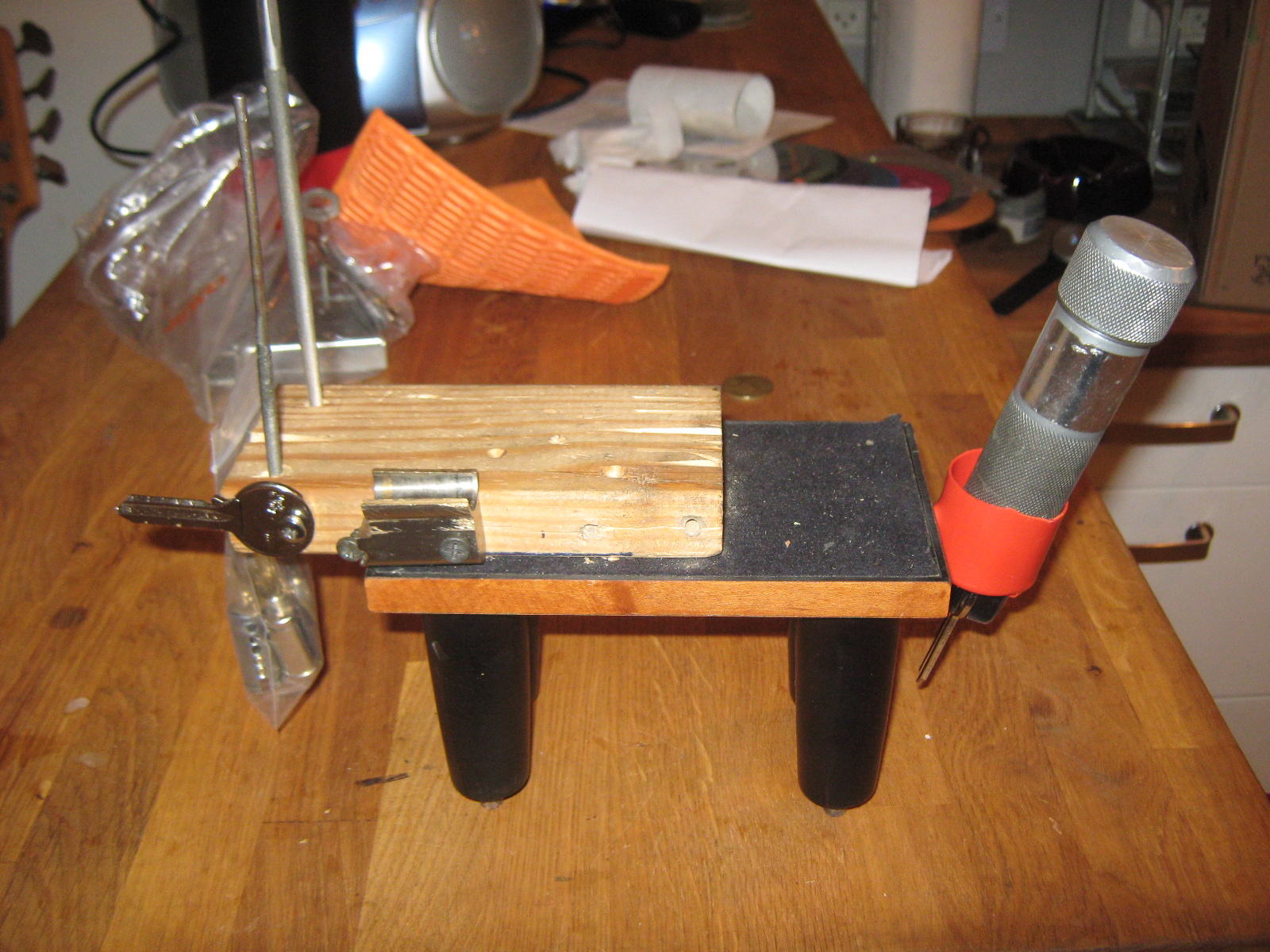
In my new station “table”   I’ve made some adjustments:

I use a few different plugs to mark the spacing on the popular locks I’m more likely to come across with.Using this comb or a file I mark down the spacing of the pins.

In here I use this key for a” backwords” impressioning when I have the plug in hand and need to file down a key.

 The wood has lanes for the key

Here is a picture on how it sits on my knee

All in all it didn’t take much time to bulid this and I must say I’m quite happy with this table.

Miwa lock

Locks from different parts of the world always makes me very curious,it’s nice to see different designs of locks  and  usually they do offer some different  protection of the lock.

This is a Miwa lock I got from a friend who had visited Japan about a year ago.At first glance the key looks normal with a double-bitted cuts but when I had a closer look I was amazed by how  this lock is designed (I would like to apologise for the quality of my pictures,but even a better photographer would have troubles showing this how beautiful this lock is)

The lock is operated by one side bar and seven sliders that moves inside the plug which is build like a tree house

Hope you can see the sliders -3 them are up to the left ,the other 4 are down

The key is very tight ,I did see a picking tool for this lock but I don’t think it will be very easy,impreesioning might be the best way

Here  is the side bar

All in all this is a very interesting lock and I do hope I will get more of them in the future!

EPG-Faster than A Key?


As a locksmith and a lock picker I have an enormous  amount of locksmith tools, I like buying tools and always willing to try something new ,but the real fact that on a real job my tool bag is not that full ,I will only use 4-5 different picks that would be the most likely to work.

The EPG (electric pick gun) is defiantly my first choose as it will save time and has a very high chances of success.

The first EPG I got cost me hundreds of Pounds ,it was an EPG from Wendt , a very powerful tool ,very heavy and uncomfortable as you have to carry the charger with you and basically would always fail on a real job..  (but will work great on the vice) . Back then I wasn’t that experienced and was still at the stage of thinking that the tool is doing the job for you which is ridiculous and there is not a single lock pick in the world that will pick a lock by itself.

EPG  however is  a time saver as it will require less skill but a good tension and a feel inside the lock is a must . non of my friends who never picked a lock in their life manged to pick a lock with the EPG .

So I sold the German tool to more appropriate  locksmith and got myself a Klom EPG which is a great tool with some great results,only trouble that I had to buy 2 more guns as they all died on me in less than 10 mounts each.

Last month my 3rd Klom stopped working so I decided to got a different EPG ,I have tried the HPC and didn’t like it so I had to choose from a Dino or Trade Locks EPG .

The Dino got some very good reviews from my friends but I was told you have to hold it upside down in order for him to work ,TL EPG was tested by Martin Pink which is in my opinion one of the most knowledgable locksmith in the world and I must add a very nice and helpful person so I went for TL’s EPG.

The EPG came in on Monday after which was the fastest delivery ever from the UK to Israel, I read the instructions very carefully and had to wait almost 2 hours for the battery to recharge and let me tell that it wasn’t easy with all the locks that were waiting to be tested. Any way this was done and off I went to pick some locks.

My first try was a disaster as I couldn’t pick any thing, I misunderstood how powerful the EPG is and broke 2 picks so I had to change strategy if I wanted anything done.

After a some modifications to the pick blades and trying different tension – in versions places of the key hole something unbelievable had happened -locks started to surrender like flies!

The most important point with using  EPG is the  tension ,it must  be very gentle and used in a way that won’t block the pick blade. I use this tension wrench that is placed in the bottom of the key allowing the blade to move freely

I’ve also changed the gun’s push buttons as I found it easier to operate with an on/off switch buttons instead of a button I would have to push.

In general I  would highly rate this tool but I guess I will have to wait and give it more time but I did look inside the tool and looks of a good quality.

I’ve also made this little carry bag for the tool with a side pocket

 Here is the EPG in action